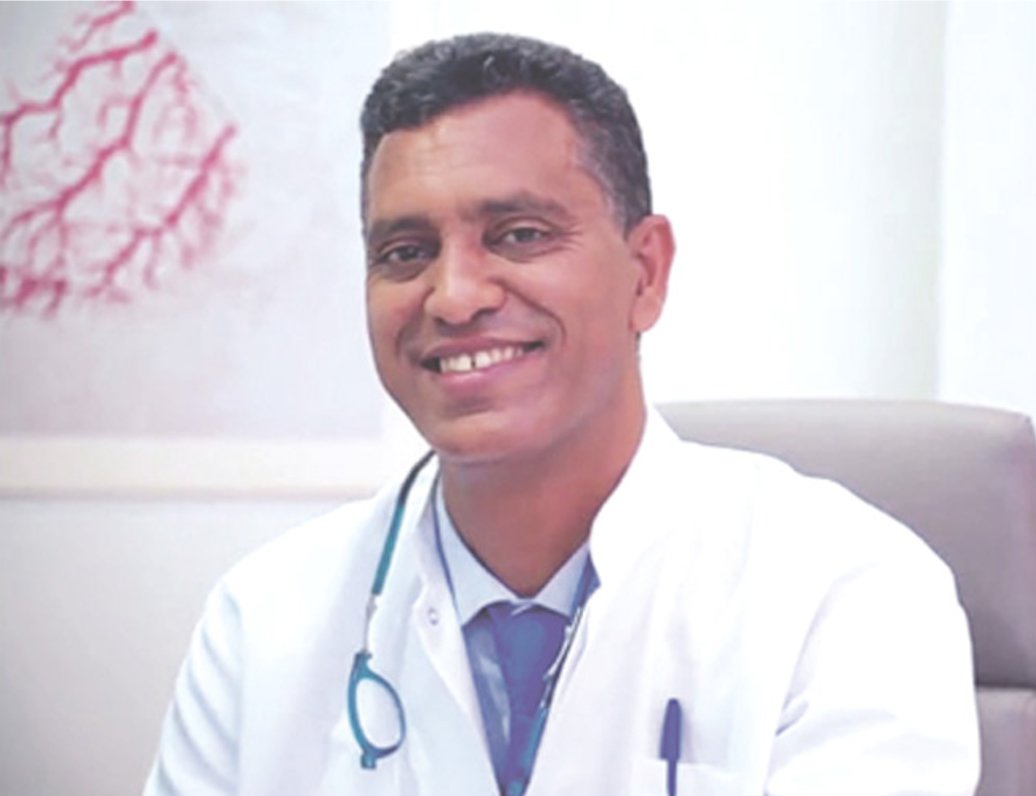
From my earliest years of medical school, I have accompanied patients through their trials, their suffering, and their battles against illness. A professor of vascular surgery and former head of department at the Military Hospital, I have dedicated over thirty years to medicine,
surgery, and research.
These years have taught me what a body and mind go through
after major cardiovascular surgery, after a stroke leaving a neurological deficit, after a cancer hospitalization that turns an entire life upside down: the patient’s life, but also that of their family.
One question, however, kept recurring.
What happens to the patient afterwards?
What happens when the emergency is over, the intervention is finished, the life has been saved—but the person hasn’t yet regained their own?
Because leaving the hospital doesn’t always mean being cured. For many, it’s the beginning of a long road. After a severe cardiovascular or neurological condition, it’s sometimes necessary to relearn actions that seem second nature: getting up, standing, walking, using a hand, speaking, eating independently, regaining balance and autonomy.
Throughout my career, I’ve met many patients in this situation. I’ve seen their courage as much as their suffering. Above all, I’ve seen the suffering of their loved ones. I remember families asking me the simplest questions:
« Professor, what do we do now? Where can we take him? Who will help him recover? »
Simple questions. But when answers are lacking, they become the most difficult of all.
Then came the pivotal moment. The day my own parents needed support during their illness, these questions ceased to be those of a doctor and became those of a son. I searched for a place that was both deeply humane and fully competent, where they would find comfort, dignity, and quality care during their recovery. What I was looking for then, I decided to build.
The idea matured: that of a place that would take over once the acute phase ended. A place where patients wouldn’t simply be told, “Your procedure went well,” but where they would continue to be supported until they regained their lives. I took the time to visit several rehabilitation and convalescent centers in Switzerland, Germany, and Spain to observe, learn, and draw inspiration from the best models of post-acute and rehabilitation care. From these trips, a conviction was born: to create a center here in Marrakech that meets these high standards. What began as a doctor’s reflection, informed by family experience, has thus become a life project and a commitment to continuity of care.
This center was designed for them.
- For this stroke survivor who dreams simply of taking a few steps on their own again.
- For this person who, after major surgery, wants to regain enough strength to return home.
- For this patient whose hand, immobilized for so long by illness, is finally beginning to move again.
- For this mother who wants to regain her independence.
- For this father who wants to be reunited with his loved ones.
- And for their families, who watch for progress that may seem tiny to others, but represents an enormous victory to them.
It is these small victories that give our work its true meaning.
We don’t receive a medical file; we receive a person. A person with a story, who knows fear, who holds onto hope, and whom a family is waiting for. A person who deserves that we mobilize all our skills to offer them the best possible chance of regaining their independence and dignity.
A place worthy of these ambitions
This is how the International Center for Post-Acute and Rehabilitation Care was born. Located forty kilometers from Marrakech, on a hillside facing the Atlas Mountains, surrounded by greenery and olive groves, it was designed as a true haven of rejuvenation, where calm and nature are integral to the care provided. Our mission extends beyond medical treatment. We support each patient in their recovery and each family during this time when one can feel so alone in the face of a loved one’s illness. Patients and families find here a supportive and attentive team, in an environment designed to breathe new life into existence. It is this story, made up of human experience as much as medical expertise, that animates our center every day. Finally, I have a thought for my mother and father, who are integral to the story of this project. Perhaps this is, ultimately, the deepest reason for my commitment: to build what I would have wanted to find when my own parents needed it. And to ensure that each patient entrusted to us is accompanied with the attention, high standards and humanity that we would wish for one of our own.
Because behind every patient, there is a life. Behind every illness, a story. And behind every step forward, however modest, a hope is reborn.
Rimply dummy text of the printing and tRimply dummy text of the printing and typesetting industry. psum has been the industry.
Robert Adison
Professor
Rimply dummy text of the printing and tRimply dummy text of the printing and typesetting industry. psum has been the industry.
Robert Adison
Professor
Rimply dummy text of the printing and tRimply dummy text of the printing and typesetting industry. psum has been the industry.
Robert Adison
Professor
Rimply dummy text of the printing and tRimply dummy text of the printing and typesetting industry. psum has been the industry.
Robert Adison
Professor
Rimply dummy text of the printing and tRimply dummy text of the printing and typesetting industry. psum has been the industry.
Robert Adison
Professor
Rimply dummy text of the printing and tRimply dummy text of the printing and typesetting industry. psum has been the industry.
Robert Adison
Professor
Rimply dummy text of the printing and tRimply dummy text of the printing and typesetting industry. psum has been the industry.
Robert Adison
Professor